The hardest part of the mental load is that it does not look like work. Nobody sees it, including the person doing it, which makes it very difficult to divide.
So this is a list. Not advice, not a reframe. A list of the specific jobs that usually sit with one parent, written down so they can be pointed at.
Print it, screenshot it, or read it out. It works best when both parents look at it at the same time and each one says which items they currently hold.
Key Takeaway: The mental load is the invisible work of noticing, remembering and deciding, which usually sits with one parent even in households that split physical chores evenly. The Office for National Statistics puts women at 26 hours of unpaid work a week against 16 hours for men. The most effective way to redistribute it is to make it visible first, by listing the specific recurring jobs and naming who currently holds each one, rather than agreeing in general to share more.
Why a List Works Better Than a Conversation
Most attempts to share the mental load start with a conversation about fairness, and stall in the same place. One person feels overloaded and cannot produce evidence. The other genuinely does not see the work and feels accused.
Both are being honest. The work is invisible by design: its whole function is that somebody has already handled it before it becomes anyone else's problem.
A list changes the conversation from "you don't do enough" to "who is holding this one". That is answerable, and it does not require anyone to be wrong.
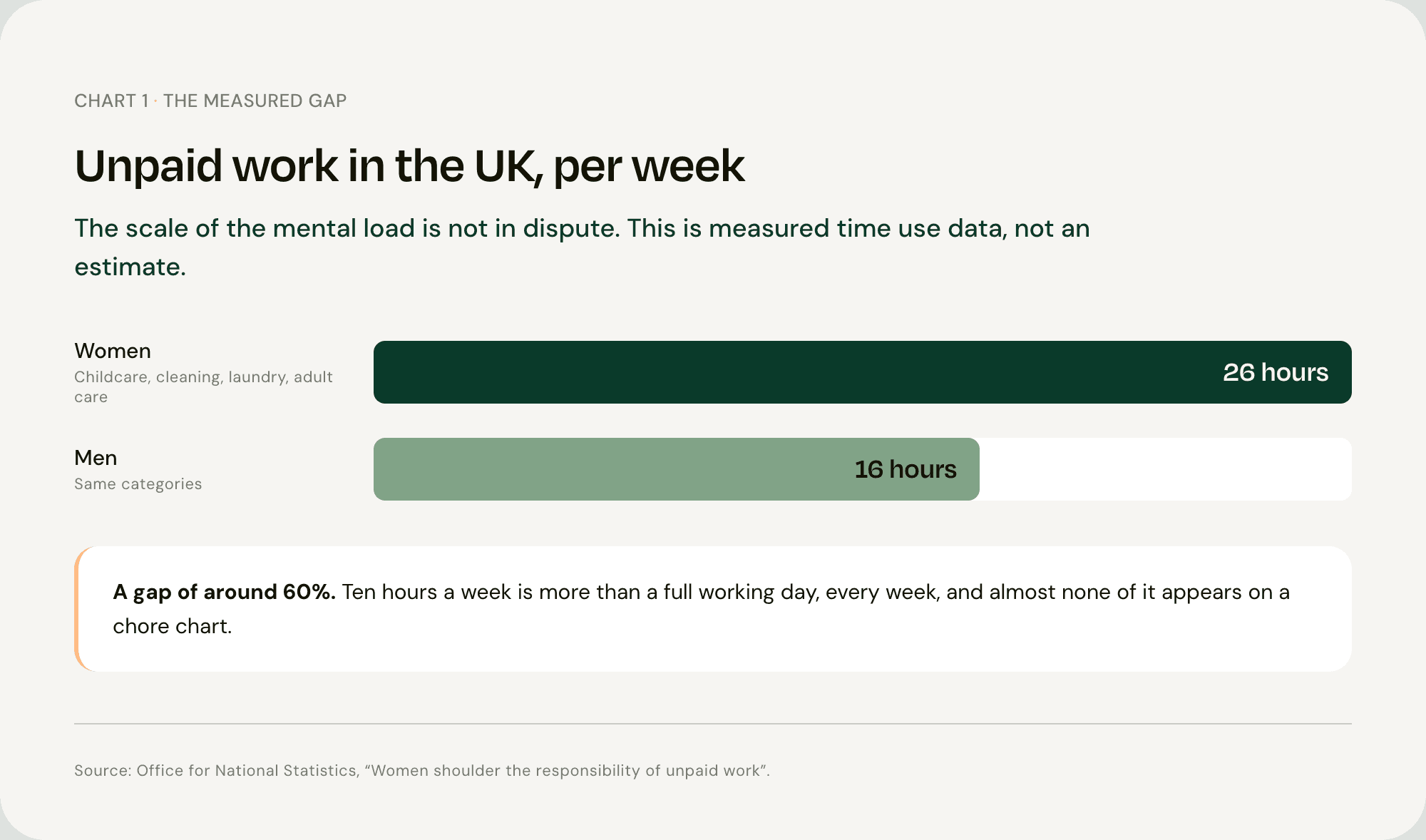
The scale is not in dispute. The Office for National Statistics puts women at 26 hours of unpaid work a week against 16 hours for men, a gap of around 60% [1]. That includes childcare, cleaning and laundry, and it is measured, not estimated.
The Checklist
Six categories. Go through them and mark each item M, P or B: mostly me, mostly my partner, or genuinely both.
The point is not to end with an even split. It is to end with an accurate picture.
School and Nursery
Knowing which of those emails contained a date
Term dates, INSET days and the ones that changed
Non-uniform days, dress-up days, own-clothes days
Reading week, book fair, sports day, class assembly
Trip consent forms and their deadlines
Payments for trips, lunches and clubs
Parents' evening bookings
Knowing which teacher, which class, which door
The class WhatsApp group, and which message in it mattered
Health and Appointments
Noticing that a check-up is due
Booking dentist, optician, GP, immunisations
Knowing which child had which appointment when
Prescriptions, repeat prescriptions and running out
Filling in the forms
Rearranging work around all of it
Activities and Social
Signing up before the club fills
Knowing what kit is needed and whether it still fits
Which Saturday is a fixture and which is a match away
Birthday party invitations, RSVPs and presents
Remembering whose birthday is coming
Playdates, and who owes whom
Holiday clubs, booked months early
The House and the Admin
Insurance renewals, car, home, pet, travel
MOT, service, tax
Subscriptions that renew silently
Bills changing, tariffs ending
Broken things, and who is chasing the repair
Passports and their expiry dates
The Invisible Layer
This is the category that usually decides the conversation, because none of it appears on a chore chart.
Holding the whole schedule in your head as a running model
Noticing that something is about to become a problem
Remembering what was decided last time
Knowing what everyone needs before they ask
Being the person the school phones first
Being the person the other parent asks
Deciding, all day, in small amounts
The Emotional Layer
Managing how everyone is feeling about the week
Smoothing over the disappointment when a plan changes
Remembering which child needs what kind of reassurance
Keeping in touch with extended family
Thank-you messages, cards, gifts
What to Do With the Answers
Two things, and only two. Long action plans do not survive a Tuesday.
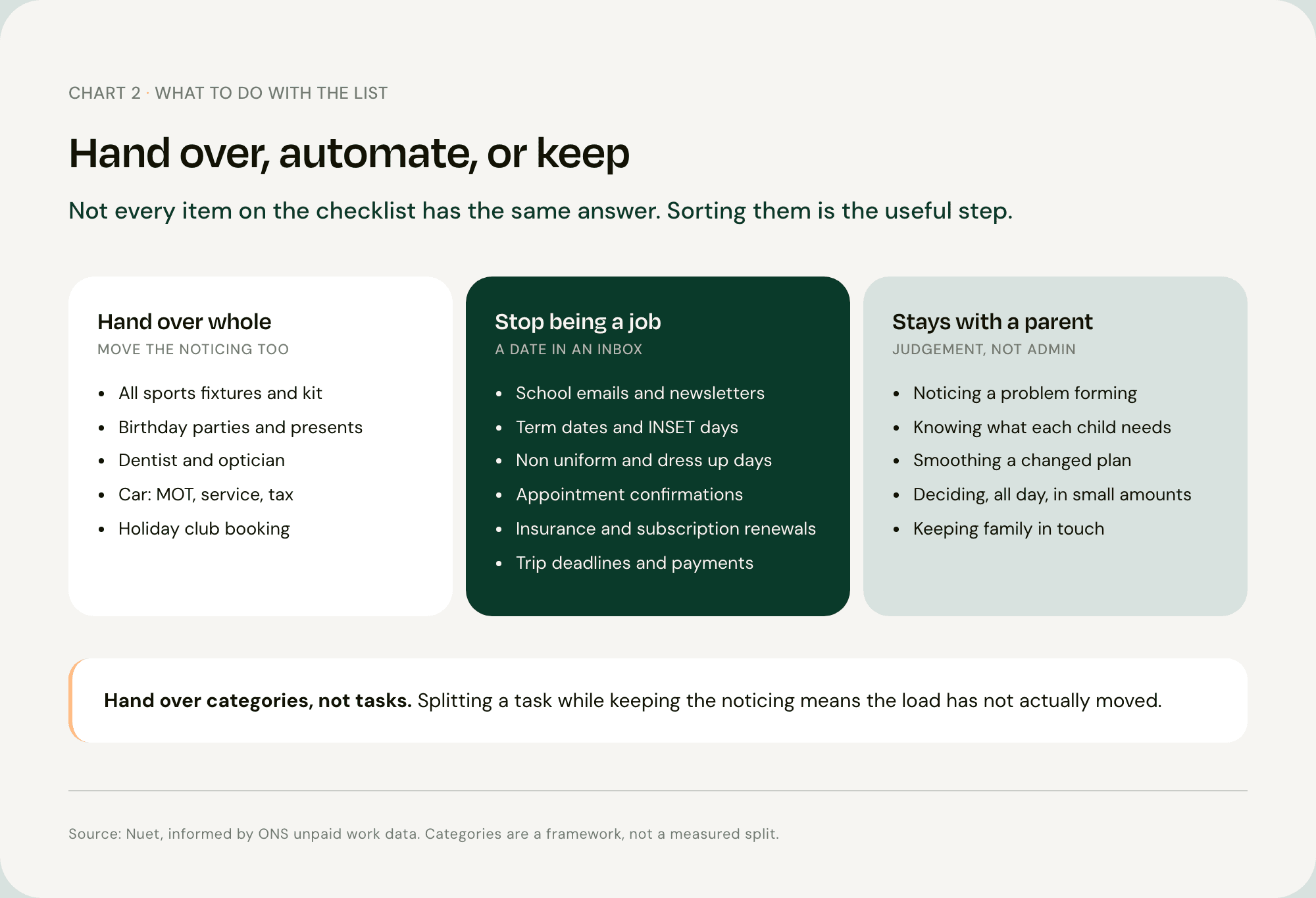
First, hand over whole categories rather than individual tasks. "You own all sports fixtures" works. "Can you help with sports sometimes" does not, because the noticing stays with the original owner and noticing is the actual work.
Second, take the remembering out of the system where you can. Some of the list is judgement and belongs to a person. A lot of it is a date sitting in an email that somebody has to spot, and that part does not need a human at all.
Which Parts Can Stop Being Anyone's Job
Look back at the School and Admin sections. Almost every item there starts the same way: something arrives, somebody reads it, somebody spots a date, somebody types it into a calendar.
Nuet does that part. It connects to your Gmail or Outlook inbox and creates the events from what arrives, then writes them into the calendar you already use. It reads photos of letters, PDFs and voice notes too, so the sheet at the bottom of a school bag becomes a calendar entry without anyone transcribing it. You choose which senders it reads, and no emails are stored on external servers.
Both parents then see the same dates without either one being the person who found them.
It will not touch the Emotional or Invisible layers, and it would be silly to claim otherwise. Those are the parts that genuinely need a parent. But it does remove a meaningful slice of the list, and it removes it rather than reassigning it.
FAQ
Q: What is the mental load? The invisible work of noticing, remembering, planning and deciding for a household. It is separate from physical chores, which is why it can sit almost entirely with one parent in a home where the washing-up is split evenly.
Q: Why does the mental load usually fall on mothers? Measured time-use data shows the gap clearly: 26 hours of unpaid work a week for women against 16 for men in the UK [1]. The reasons are cultural rather than individual, but the effect on a specific household is practical and can be redistributed.
Q: How do you actually split the mental load? Hand over entire categories rather than individual tasks, so the noticing moves with the job. Splitting a task while keeping the noticing means the load has not moved at all.
Q: Does a shared calendar fix the mental load? Partly. It fixes visibility, so both parents can see what is coming. It does not fix data entry, because somebody still has to read the email and type the date in. That remaining step is where a lot of the load lives.
Q: Can any of this be automated? The parts that are just a date arriving in an inbox, yes. Nuet reads school and admin email and creates the calendar events automatically. The judgement and emotional work cannot be automated and should not be.
Sources
[1] Office for National Statistics — Women shoulder the responsibility of 'unpaid work' [2] Office for National Statistics — Time use in the UK [3] Office for National Statistics — Changes in the value and division of unpaid care work in the UK [4] Nuet — Nuet: Smart Family Calendar on the App Store [5] Nuet — MadeForMums Tech Awards 2026 Gold winner